
Voltage Drop Calculator for EV Chargers
Percent drop for any run length, conductor size and charger load, single phase at 240, 208 or 120 V.
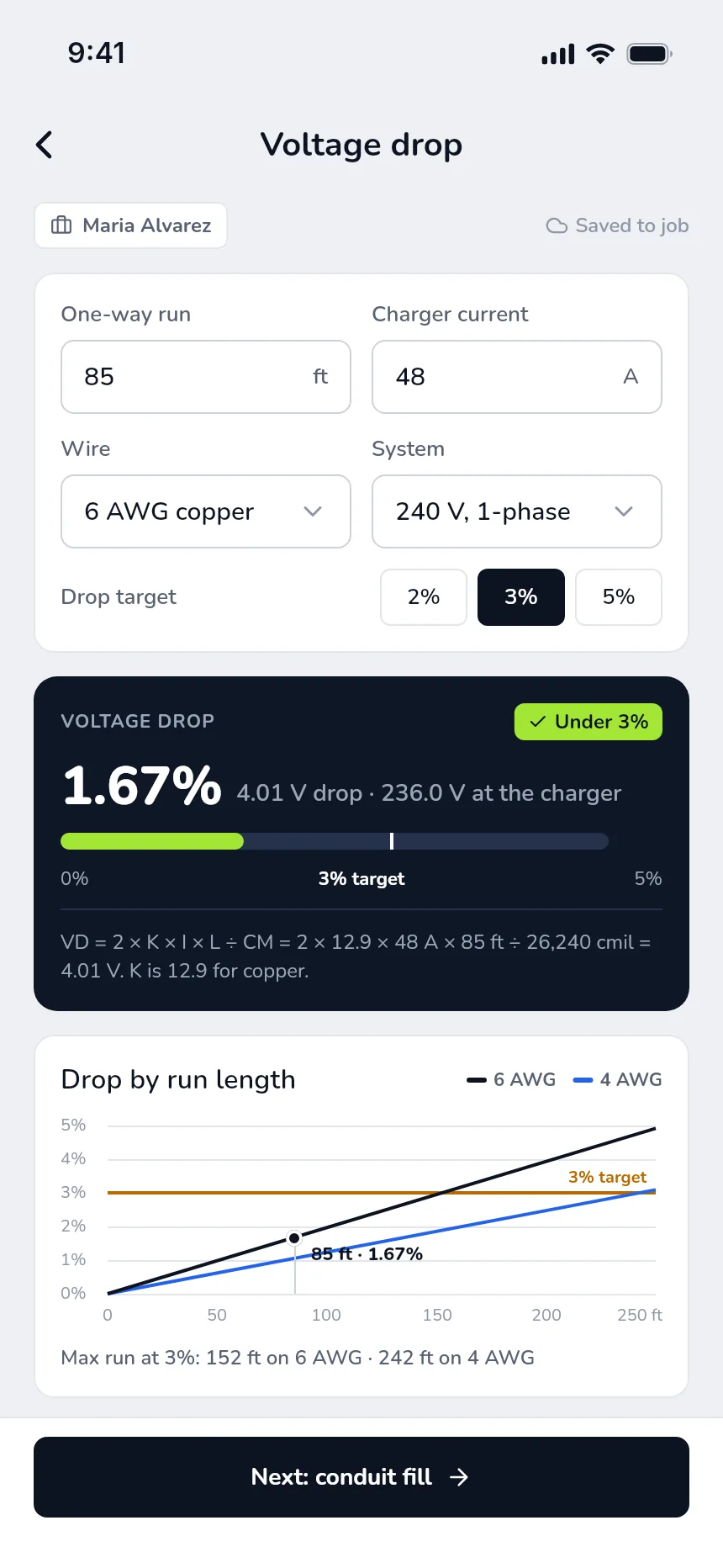
1.67 % drop
How the drop is worked out
For a single-phase circuit the drop is VD = 2 × K × I × L ÷ CM: K is the conductor's resistivity (12.9 ohm-cmil/ft for copper, 21.2 for aluminum), I the load in amps, L the one-way length in feet and CM the conductor's area in circular mils from Chapter 9, Table 8. The percent is VD divided by the circuit voltage.
Use the charger's actual current (48 A for a 48 A charger), not the 125% circuit size: voltage drop depends on the current that really flows.
How much drop is OK?
The NEC's informational notes recommend no more than 3% on a branch circuit and 5% for feeder and branch circuit together. It is a recommendation, not a requirement, but a charger on a long run with a big drop charges slower, and some chargers report under-voltage faults.
When the drop is too high, go up a conductor size. If you upsize the conductors for drop, 250.122(B) says the equipment ground is upsized in proportion. Size the circuit first with the wire and breaker calculator.
Run the numbers on site
Panel load, wire size, voltage drop and a PDF quote in one app.
FAQ
Questions people ask
Short answers about this free tool.
At what distance does voltage drop matter for an EV charger?
For a 48 A charger on 6 AWG copper at 240 V, the drop passes 3% at around 150 ft. For smaller chargers and larger wire the distance is longer. Run the numbers on anything over about 100 ft.
Should I use the breaker size or the charger amps?
The charger amps. The breaker is sized at 125% for heat, but the drop depends on the current actually flowing, which is the charger's rating.
Is the run length one-way or round trip?
One-way, from the panel to the charger. The formula's factor of 2 accounts for the return path.
Does voltage drop apply at 208 V?
Yes, and it matters more: the same drop in volts is a bigger percent of 208 V. Chargers also deliver less power at 208 V.