EV Charger Load Calculation: NEC 220.82 Step by Step
A worked example on a 200 A service: general load, the first 10 kVA, heating and A/C, then the charger. How to tell whether the service can carry a Level 2 charger.

The EV Charger Calc team
Nov 24, 2026 · 3 min read
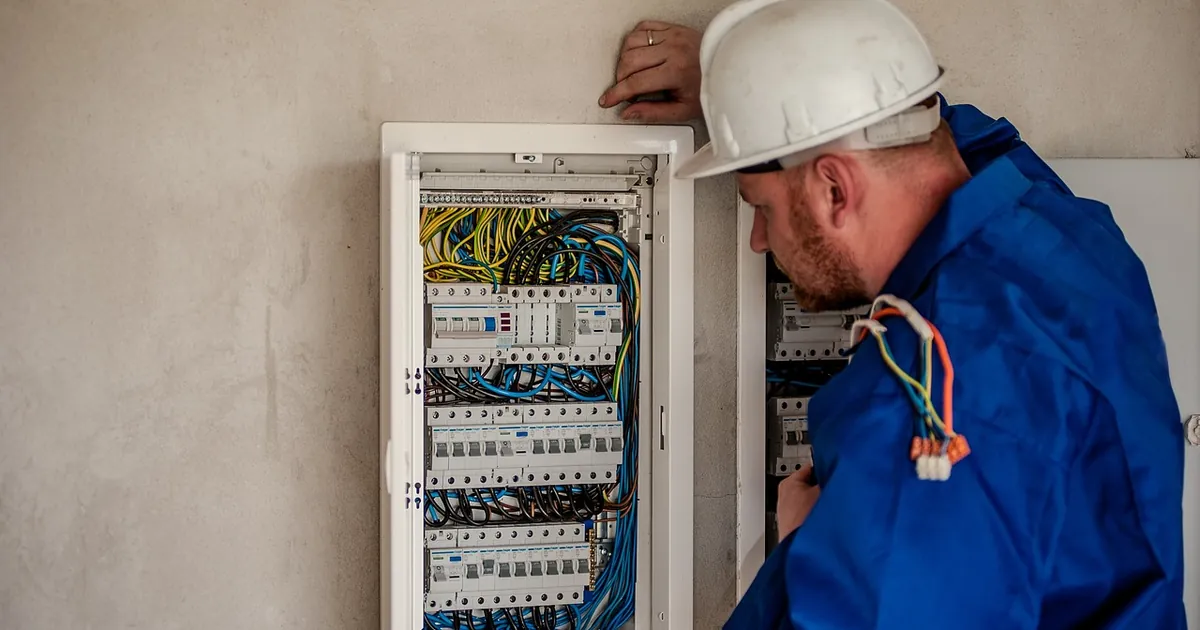
Before you quote a Level 2 charger, you need to know whether the service can carry it. For a single-family home, the NEC's optional method in 220.82 is the fastest way to answer that, and it's the method most electricians and inspectors use for this job. Here's a full worked example.
When you can use it
220.82 applies to one dwelling unit with a 120/240 V or 208Y/120 V, 3-wire service or feeder of 100 A or more. It replaces the longer standard method with one demand factor for the general load and a simpler heating and cooling rule.
The house in this example
- 200 A service
- 2,400 sq ft of living area
- 3 small-appliance and laundry circuits (two kitchen, one laundry)
- Fixed appliances, nameplate: electric range 12,000 VA, dryer 5,000 VA, water heater 4,500 VA, dishwasher 1,200 VA (22,700 VA total)
- Central A/C, 5,760 VA (24 A at 240 V); gas furnace
- New 48 A EV charger
Step 1: general load
220.82(B) adds up:
| Item | Calculation | VA |
|---|---|---|
| Lighting and receptacles | 2,400 sq ft × 3 VA | 7,200 |
| Small-appliance and laundry circuits | 3 × 1,500 VA | 4,500 |
| Fixed appliances | Nameplate total | 22,700 |
| EV charger | 48 A × 240 V | 11,520 |
| General load | 45,920 |
The charger counts at its nameplate rating, like any appliance on a specific circuit. If it's set lower with restricted access (625.42), use the setting.
Step 2: apply the demand factor
The first 10 kVA at 100%, the rest at 40%:
- First 10,000 VA × 100% = 10,000 VA
- Remaining 35,920 VA × 40% = 14,368 VA
- General load after demand = 24,368 VA
This is why the optional method is kind to EV chargers: most of the charger's load lands in the 40% portion.
Step 3: heating or cooling
220.82(C) adds the largest of these:
- Air conditioning and cooling at 100%
- Heat pump compressor at 100% plus supplemental heat at 65%
- Central electric space heat at 65%
- Fewer than four separately controlled electric space heaters at 65%
- Four or more separately controlled heaters at 40%
Our house has gas heat, so the A/C wins: 5,760 VA.
Step 4: total and amps
- Total = 24,368 + 5,760 = 30,128 VA
- 30,128 ÷ 240 V = 125.5 A
On a 200 A service, that's about 63% of the rating, with 74.5 A to spare. The charger fits.
The same house on 100 A
Change only the service to 100 A, and 125.5 A is over the rating. Before you write up a service upgrade:
- Turn the charger down. At 32 A, the EV adds 7,680 VA instead of 11,520 VA. That saves 3,840 × 40% = 1,536 VA, or about 6 A. Not enough here.
- Use load management. An energy management system (625.42, 750.30) or a load-sensing charger keeps the charging current below what the service can spare.
- Measure the real demand. 220.87 lets you use the highest demand over the past 12 months, times 125%, plus the new load. Utilities can often provide the data, or you can record it for 30 days under the method's rules.
- Upgrade the service if none of those work.
We'll cover the 100 A case in detail in a separate guide.
Common mistakes
- Forgetting the small-appliance circuits. Every dwelling has at least three (two kitchen, one laundry).
- Counting A/C and heat together. Take only the larger.
- Using the breaker size for the charger. Use the charger's rating (48 A), not the 60 A breaker.
- Using 220.82 on a multifamily feeder. It's for one dwelling unit.
Do it in a minute
Our free EV charger load calculator runs 220.82 with your numbers and shows the spare capacity. Then size the branch circuit with the wire and breaker size calculator; for a 48 A charger that's a 60 A breaker and 6 AWG copper in conduit, as explained in what size wire for a 48 amp EV charger.
The EV Charger Calc app saves the load calculation with the job and puts it on the PDF quote, so the customer and the inspector see the same numbers.
Frequently asked questions
When can I use the 220.82 optional method?
For a single dwelling unit served by a 120/240 V or 208Y/120 V, 3-wire service or feeder with an ampacity of 100 A or more. Multifamily buildings and commercial services use other methods.
How does the EV charger count in 220.82?
At its nameplate rating (or its restricted-access adjusted setting), in the general load with the other fixed appliances, so it falls under the 10 kVA at 100% / remainder at 40% demand factor.
What's the difference between 220.82 and 220.87?
220.82 calculates the load from what's installed. 220.87 uses the highest measured demand over the last year, times 125%, plus the new load. For existing homes it often shows more spare capacity.
Is the calculated load the same as the actual load?
No. It's a code calculation with demand factors that assume not everything runs at once. Real usage is usually lower.